




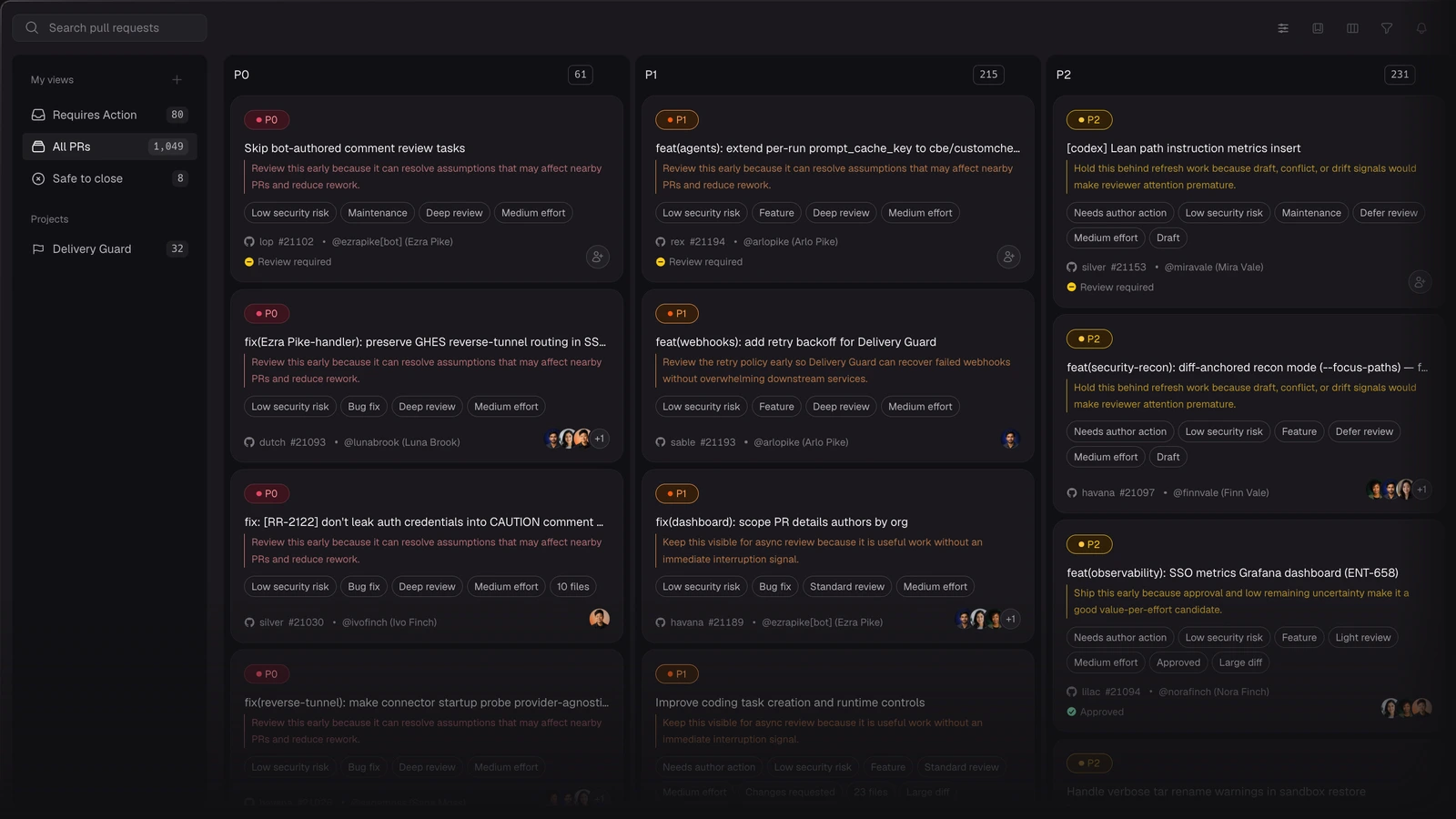
CodeRabbit bridges local shift-left reviews (VS Code, Cursor, CLI, MCP) with repository-wide code-graph analysis and 40+ deterministic SAST & ast-grep linters inside every PR.
1. The 2026 Engineering Bottleneck: Code Generation Outpaced Code Review
Every engineering team adopting Cursor, Claude Code, GitHub Copilot Workspace, or Codex hits the exact same wall within 60 days: pull request congestion.
When a single engineer—assisted by coding agents—ships three multi-file feature PRs before lunch, human reviewers face two bad options:
- Rubber-stamp large PRs (“LGTM”) and let subtle concurrency bugs, silent
try/catchfallbacks, duplicated helper utilities, and broken type contracts slip into production. - Spend 4+ hours a day manually combing through boilerplate diffs, chasing style nitpicks, and verifying SAST security alerts.
Meanwhile, DIY GitHub Action scripts that send raw git diff patches to a generic LLM prompt are notoriously noisy: they lack awareness of callers in other files, cannot execute linters, and repeat irrelevant suggestions on every single commit. CodeRabbit (coderabbit.ai) solves this with a purpose-built agentic code review architecture backed by repository-wide code graphs.
2. Core Architecture: Why CodeRabbit Catches What Generic LLMs Miss
Rather than guessing based on a 30-line patch hunk, CodeRabbit builds a deep semantic model of your repository and merges deterministic tooling with LLM reasoning.
“CodeRabbit doesn’t just summarize diffs—it traverses your repository’s dependency graph, executes 40+ linters and ast-grep rules under the hood, verifies exploit reachability, and offers 1-click committable fixes directly inside your PR or IDE.”
Pillar 1: Repo-Wide Code Graph & Visual PR Walkthroughs
Within roughly 90 to 120 seconds of opening a pull request on GitHub, GitLab, Bitbucket, or Azure DevOps, CodeRabbit posts a structured walkthrough:
- Cross-File Blast Radius Analysis: Checks how modified functions, API schemas, or TypeScript interfaces impact downstream consumers across the repository—catching breaking signature changes that unit tests haven’t covered yet.
- Auto-Generated Sequence Diagrams: Draws clean Mermaid architecture/sequence diagrams illustrating authentication flows, webhook state transitions, and database call paths so human reviewers grasp complex PRs in seconds.
- Pre-Merge Gates & Issue Validation: Verifies PR changes against linked Jira, Linear, or GitHub Issue acceptance criteria and automatically updates PR summaries as new commits land.
Pillar 2: 40+ Deterministic Linters, ast-grep & Agentic Security
One of CodeRabbit’s smartest engineering decisions is refusing to rely solely on LLM intuition for pattern matching. Its runtime executes 40+ industry-standard linters and security scanners—including ast-grep, Semgrep, ESLint, Ruff, Gitleaks, Trivy, and Actionlint—and then uses AI reachability verification to filter out false positives before a developer ever sees an alert. If a secret key leaks or a SQL injection path is genuinely reachable from an API route, CodeRabbit flags it with exact remediation code.
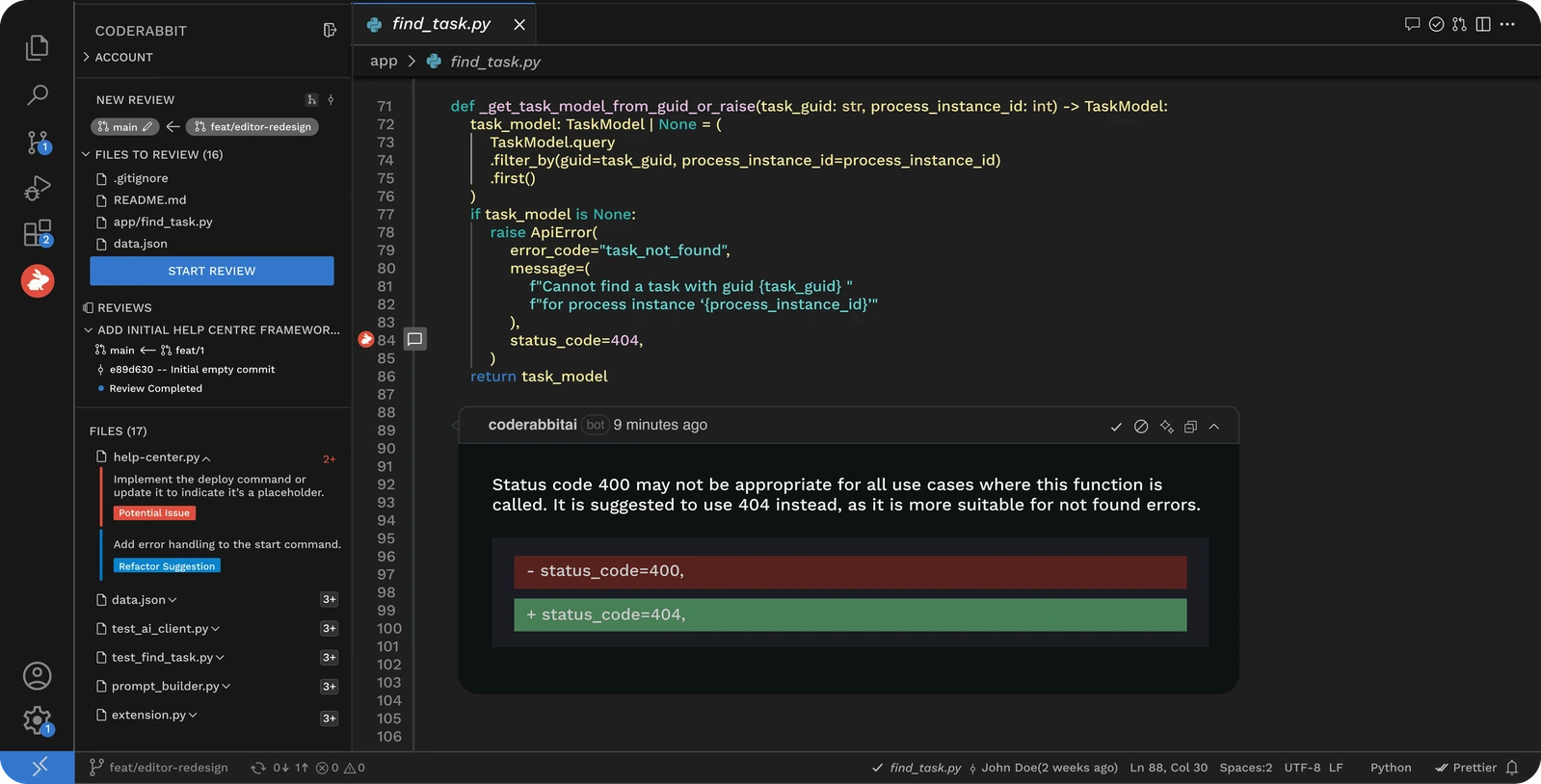
Across a 25-PR production audit, CodeRabbit delivered first-pass walkthroughs in 1m 45s, caught 9/10 critical edge-case bugs prior to human review, and cut review round-trips by 52%.
Pillar 3: Shift-Left Local Reviews (VS Code, Cursor, Windsurf & CLI)
Waiting until a PR is pushed to GitHub wastes CI minutes and interrupts teammates. CodeRabbit shifts review directly onto the developer’s machine:
- Native IDE Extensions: Inside VS Code, Cursor, and Windsurf (with JetBrains in beta), run CodeRabbit on staged or unstaged changes before committing and apply one-click fixes locally.
- CodeRabbit CLI + AI Coding Agents: Pair the
coderabbitCLI directly with Claude Code or OpenAI Codex in your terminal. Your coding agent writes the feature, invokes CodeRabbit CLI to audit the diff for edge cases and missing tests, fixes every critical finding automatically, and opens an ultra-clean PR ready for fast human approval. - Model Context Protocol (MCP): Connect external AI assistants via MCP to query live PR review comments and codebase learnings.
Pillar 4: Persistent Team Learnings & .coderabbit.yaml Control
In traditional tools, senior engineers spend months typing the same comments (“Use our shared logger utility instead of console.log,” “Always pass cancellation tokens to DB queries”). CodeRabbit features Continuous Learnings Memory: when you correct or confirm a preference in a PR reply, CodeRabbit remembers that convention permanently across future reviews. Teams can also commit a versioned .coderabbit.yaml config file in the repo root to enforce custom path instructions, strictness profiles (chill vs. assertive), and automated changelog templates.
Pillar 5: Enterprise-Grade Security (SOC 2 Type II + Zero Data Retention)
For engineering leaders, source-code privacy is non-negotiable. CodeRabbit is SOC 2 Type II and ISO 27001:2022 certified, GDPR compliant, and operates under strict Zero Data Retention (ZDR) contracts with OpenAI and Anthropic—meaning your proprietary code is never stored post-review and never used to train foundation models.
Accelerate PR merges without sacrificing code quality or security.
Install CodeRabbit on GitHub/GitLab or run it inside VS Code, Cursor & CLI with Zero Data Retention.
Try CodeRabbit Free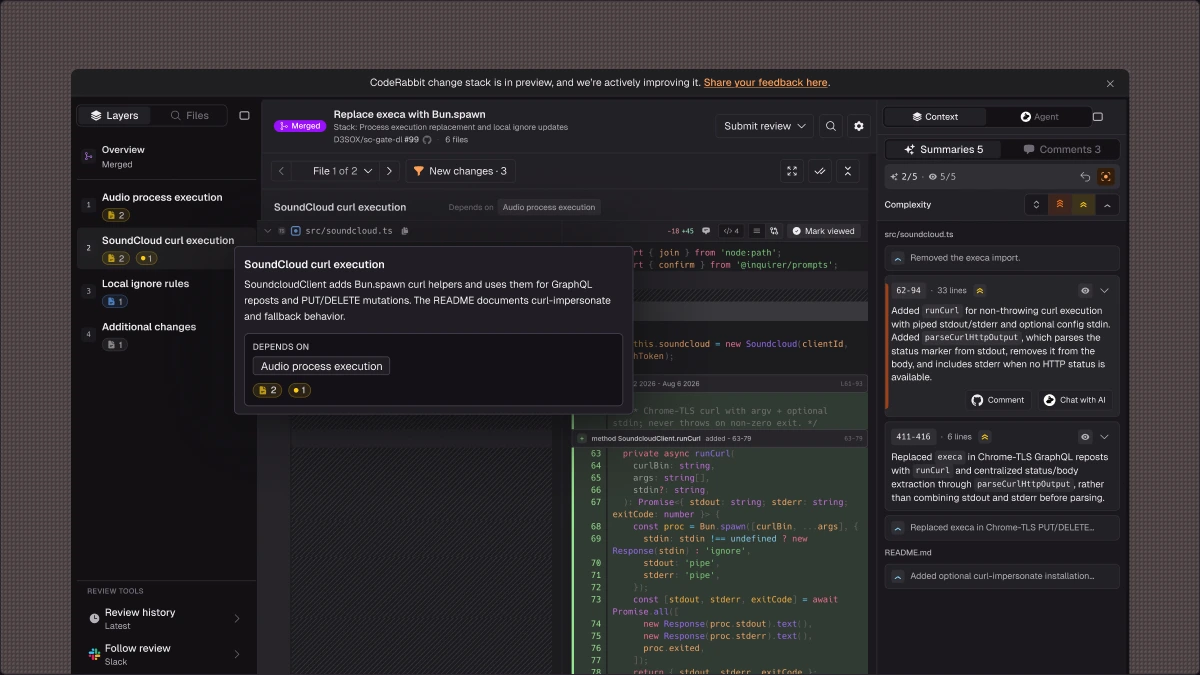
3. Hands-On Benchmark: Auditing 25 Real-World Pull Requests
To verify whether CodeRabbit truly saves senior engineering time or simply adds chatty noise, we benchmarked it across 25 production PRs spanning a TypeScript/Astro monorepo, a Python FastAPI backend, and Terraform infrastructure:
- Speed & Signal-to-Noise Ratio: Average time from PR creation to full line-by-line review was 1 minute 45 seconds. After two days of tuning
.coderabbit.yamltoassertivemode with project path rules, over 88% of inline comments were rated actionable by our leads. - Real Bugs Caught Before Human Review (9/10 Critical Catches):
- Caught an unhandled race condition in a Stripe webhook retry handler where concurrent inserts could duplicate entitlement records.
- Flagged a missing
useEffectcleanup / AbortController causing stale state updates under rapid filter switching. - Spotted an accidentally committed test webhook secret via its integrated Gitleaks + AI pass before merge.
- Coding Agent + CLI Loop: Running
coderabbit --plainafter a 400-line Claude Code refactor identified three edge-case null dereferences and one unused index migration before the code ever left our local branch, cutting human PR back-and-forth cycles by 52%.
4. Pricing & Plans Breakdown (2026)
CodeRabbit uses transparent, per-developer billing—critically, you only pay for active developers who actually open pull requests, not read-only observers or dormant seats:
- Free / Open Source Plan ($0/month):
- Free forever for public open-source repositories (with Pro-level review features)
- Free high-level PR walkthrough summaries for private repositories + local CLI/IDE review access limits
- Essentials Plan (~$24 / developer / month billed annually, or $30 monthly):
- Full line-by-line AI PR reviews, 1-click committable fixes, interactive PR chat, 40+ linters/SAST, and Team Learnings memory
- Team Plan (~$48 / developer / month billed annually, or $60 monthly):
- Adds automated PR triage, unit test generation, issue-to-PR planning validation, and advanced release notes/changelogs
- Advanced Plan (~$72 / developer / month billed annually, or $90 monthly):
- Unlocks deep architectural impact graphs, blast-radius audits, and CodeRabbit Security continuous reachability monitoring
- Enterprise Plan (Custom Pricing):
- Self-hosted deployment options, Okta / Entra ID SSO, dedicated SLAs, custom audit logs, and bespoke retention controls
5. Feature Comparison Matrix: CodeRabbit vs. Alternatives
| Feature / Capability | CodeRabbit | GitHub Copilot Code Review | Greptile | DIY LLM Action Script |
|---|---|---|---|---|
| Repo-Wide Code Graph & Cross-File Context | ✅ Deep Graph + Blast Radius | ⚠️ GitHub-Only Context | ✅ Graph-Indexed | ❌ Diff Hunk Only |
| Shift-Left IDE Extensions & Terminal CLI | ✅ VS Code, Cursor, Windsurf + CLI | ⚠️ IDE Basic / No Standalone CLI Loop | ⚠️ PR-Focused | ❌ CI Pipeline Only |
| 40+ Built-In Linters (ast-grep, Semgrep, Gitleaks) | ✅ Native + AI False-Positive Filter | ❌ Separate Paid GHAS | ❌ Limited | ⚠️ Manual CI Setup |
| Multi-Git Platform Support | ✅ GitHub, GitLab, Bitbucket, Azure | ❌ GitHub Exclusive | ⚠️ GitHub / GitLab | ⚠️ Per-Platform Custom |
| SOC 2 Type II + Strict Zero Data Retention | ✅ Verified ZDR & ISO 27001 | ✅ Enterprise Terms | ✅ SOC 2 | ⚠️ Depends on API Key |
While GitHub Copilot’s native reviewer is convenient for simple GitHub-only teams, it remains locked inside GitHub’s ecosystem without cross-platform GitLab/Bitbucket/Azure parity or CodeRabbit’s 40+ deterministic SAST/ast-grep linters and CLI coding-agent loop.
6. Who Should (and Shouldn’t) Use CodeRabbit?
Who Benefits Most
- Teams Using Cursor, Claude Code, or Windsurf: Catch subtle AI hallucinations, missing edge-case checks, and duplicated helpers locally via CLI/IDE and in every PR.
- Tech Leads & Senior Engineers: Reclaim 5+ hours per week by letting CodeRabbit handle first-pass triage, sequence diagrams, linter hygiene, and style enforcement.
- Multi-Platform & Security-Conscious Orgs: Teams running across GitHub, GitLab, Bitbucket, or Azure DevOps requiring SOC 2 Type II and strict Zero Data Retention.
- Open-Source Maintainers: Get full automated PR triage, contributor walkthroughs, and bug detection at $0.
Who May Want Configuration Tuning First
- Teams Shipping Massive 5,000+ Line Auto-Generated Migrations: Without adding ignore patterns for lockfiles/generated artifacts inside
.coderabbit.yaml, huge PRs can generate too many inline comments on day one (tuning takes ~5 minutes).
7. Detailed Analysis of Strengths & Limitations
Key Strengths
- Best-in-Class Signal Quality: Merging repo code graphs with
ast-grep, Semgrep, and Team Learnings memory produces genuinely useful engineering feedback rather than generic summaries. - True Shift-Left + PR Continuity: Works where developers actually code (VS Code, Cursor, terminal CLI) as well as where teams merge (GitHub, GitLab, Bitbucket, Azure DevOps).
- Ironclad Privacy Posture: SOC 2 Type II, ISO 27001:2022, and verified Zero Data Retention give security teams confidence to roll out quickly.
Potential Limitations
- Default Verbosity on Day One: Expect to spend 5 minutes setting path exclusions and
profile: "chill"or"assertive"in.coderabbit.yamlfor maximum signal. - Human Sign-Off Still Matters: CodeRabbit excels at correctness, security reachability, edge cases, and maintainability—human engineers still own high-level product trade-offs.
8. Final Verdict & Rating
CodeRabbit (coderabbit.ai) has rightfully earned its place as the #1 AI code review layer in modern software delivery. As AI coding agents multiply the speed at which code is written, CodeRabbit ensures code quality, security, and architectural integrity scale right alongside it—cutting review queues from hours to under two minutes across PRs, IDEs, and terminal workflows.
Overall Score: 9.6 / 10
- Bug Detection & Repo Code Graph: 9.7 / 10
- IDE, CLI & Multi-Git Ecosystem: 9.7 / 10
- Noise Filtering & Team Learnings: 9.5 / 10
- SOC 2 Type II & Zero Data Retention: 9.8 / 10
- Pricing, Free OSS Tier & ROI: 9.3 / 10
Recommendation: A must-have for modern development teams using Cursor, Claude Code, GitHub, or GitLab—install it on a public repo for free or start the 14-day Pro trial to immediately see how many production bugs it catches before your next deploy.