
 Gigachad Garen
But what if the solution wasn’t another app to manage, but an intelligent companion that listened, understood, and organized your life in the background?
Enter Pocket, a device that boldly bills itself as a “New Interface for Thought” and the “World’s First AI Thought Companion.” Created by HeyPocket, this unassuming, MagSafe-compatible piece of hardware aims to bridge the gap between human thought and digital action. It promises to capture your conversations, summarize your meetings, map out your ideas, and update your workflow—all without you ever needing to unlock a screen.
After thoroughly examining its specs, features, and the philosophy behind its design, here is a comprehensive review of whether Pocket truly represents the next leap in personal productivity, or if it’s just another gadget destined for the bottom of your bag.
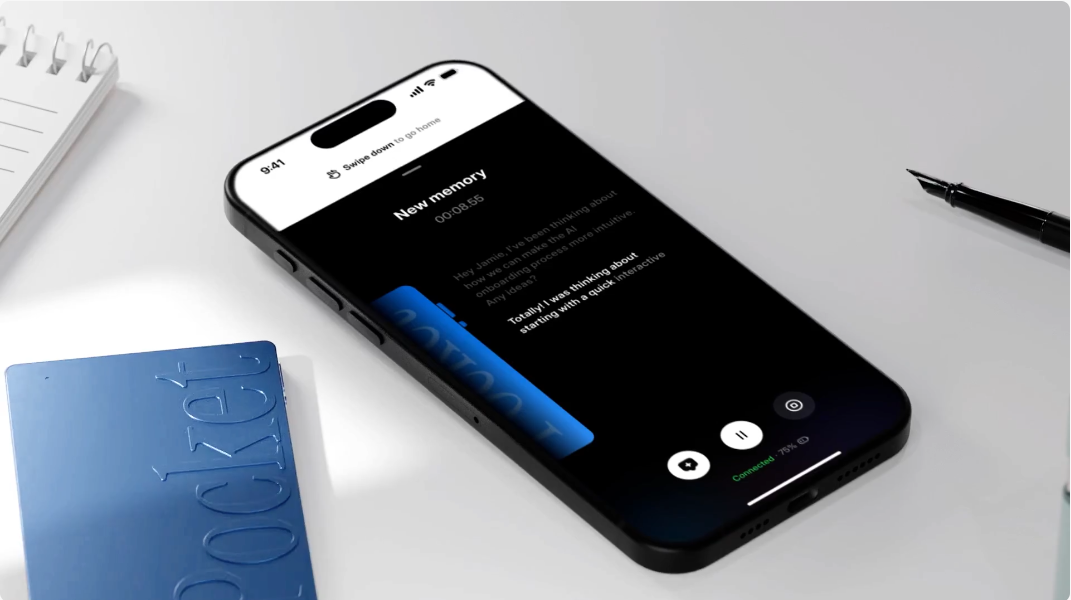
The most striking thing about Pocket isn’t what it has, but what it lacks. There is no glowing screen. There is no overwhelming array of buttons. In a market saturated with smartphones that demand our constant visual attention, Pocket’s design is a radical return to presence.
Form Factor and Hardware
At just 52 grams (1.8 oz) and measuring a remarkably slim 3.4 × 2.2 × 0.2 inches, Pocket is designed to be invisible when you don’t need it and instantly accessible when you do. It attaches to the back of your phone via MagSafe (or an adhesive mount for non-MagSafe devices), blending seamlessly into your existing everyday carry.
The aesthetic, particularly the sleek “Sierra Blue” finish, screams premium, minimalist tech. It looks less like a traditional dictaphone and more like a high-end accessory.
The Magic of the Microphones
The true hardware innovation lies in its acoustic engineering. Pocket doesn’t rely on your phone’s microphone; it features a custom triple-mic array:
- Two Studio Microphones: Designed for ambient room capture. These are optimized to record in-person meetings, group brainstorms, or your own voice memos while you walk, with a stated range of up to 15 meters (49 feet).
- One Contact Microphone: This is perhaps the most brilliant hardware feature. When attached to the back of your phone, the contact mic picks up the audio of the person on the other end of a phone call without requiring you to put the call on a speakerphone. It captures the structural vibrations of the phone itself.
This dual-capability means Pocket is equally adept at recording a boardroom negotiation as it is a private client call taken on a busy street.
Battery and Connectivity
With a claimed battery life of “4 days of active use,” Pocket addresses the biggest pain point of modern wearables: daily charging anxiety. It charges via USB-C (taking about 1.5 hours) and utilizes BLE (Bluetooth Low Energy) and Wi-Fi to sync data. Crucially, it features 64GB of onboard storage, allowing it to function completely offline, syncing only when it reconnects to your phone.
Hardware is only half the story. The brain inside Pocket is what elevates it from a mere voice recorder to a “Thought Companion.” HeyPocket has chosen a model-agnostic approach, meaning it isn’t locked into a single AI ecosystem. It leverages industry leaders like GPT-5 and Claude, automatically selecting the best model for the specific task at hand.
Unprecedented Transcription and Translation
Pocket supports over 120 languages. But mere transcription is no longer a selling point in 2026; accuracy and context are. For Pro users, the AI boasts the “highest accuracy transcription” and, crucially, auto-detects speaker names. It doesn’t just give you a block of text; it gives you a formatted script of who said what.
From Audio to Insight: Summaries and Mind Maps
This is where Pocket justifies its price tag. Once a recording stops, the magic happens in the companion app.
- Crisp Summaries: Pocket doesn’t just shorten the text; it understands the intent. Whether it’s a sprawling two-hour brainstorming session or a rapid-fire five-minute client update, the AI distills the conversation into key takeaways instantly.
- Mind Maps: For visual thinkers, this is a game-changer. Pocket can take a complex, non-linear conversation and automatically generate a branched mind map, showing how different topics connect. This is invaluable for creative work and strategic planning.
- Action Items: The AI acts as a relentless project manager. It identifies commitments, promises, and next steps made during a conversation and isolates them as clear “Action Items.”
“Ask Pocket”: Your Searchable Memory
Perhaps the most futuristic feature is Ask Pocket. Instead of scrolling through transcripts or listening to audio, you can query your own life. You can type into the app, “What did John say about the Q3 budget last Tuesday?” and Pocket will retrieve the specific context and answer you in plain language. It turns your ephemeral conversations into a structured, searchable database of your own life.
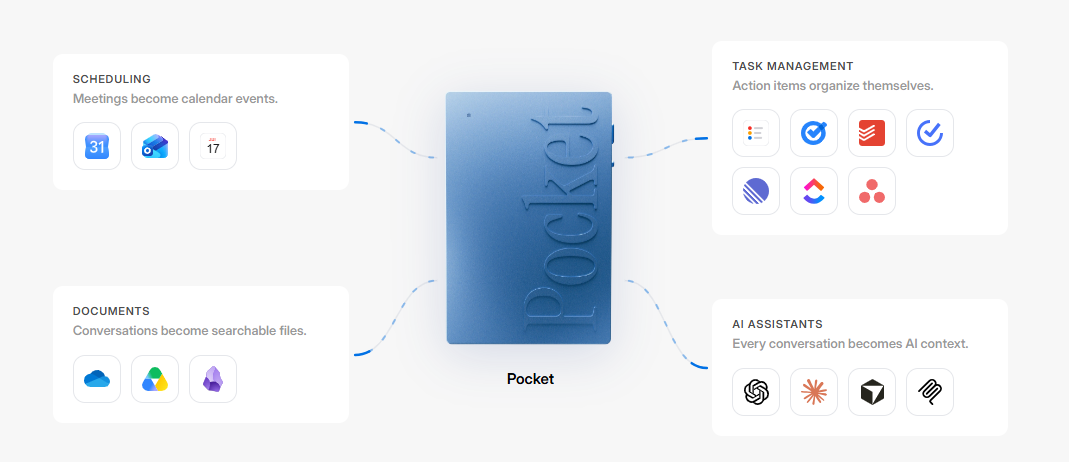
The biggest bottleneck with current AI tools is the friction of moving data. You record something, transcribe it, copy the summary, open your calendar, create an event, open your task manager, create a to-do list… it’s exhausting.
Pocket’s true superpower is its deep, automated integrations. It operates on the philosophy that a thought shouldn’t require manual labor to become an action.
- Scheduling: When Pocket hears, “Let’s meet next Thursday at 2 PM to discuss this,” it doesn’t just note it; it automatically pushes a calendar event to Google Calendar, Apple Calendar, or Outlook.
- Task Management: Those action items the AI identified? Pocket routes them directly into your preferred ecosystem. It integrates natively with Apple Reminders, Google Tasks, Todoist, TickTick, Linear, ClickUp, and Asana. The tasks organize themselves.
- Documentation: Completed transcripts and summaries can be pushed directly to Google Drive, OneDrive, or Obsidian, creating a permanent, searchable archive of your knowledge.
- AI Context: Brilliantly, Pocket can act as a context engine for other AI assistants like ChatGPT, Claude, and Cursor, feeding them your specific real-world data to make their outputs more relevant to you.
Pocket is not a toy; it is a professional productivity tool. Its marketing clearly targets specific personas who suffer most from information overload.
The Executive and the Manager
For leaders who spend their days in back-to-back meetings, Pocket offers the gift of presence. Instead of staring at a laptop screen typing notes, you can maintain eye contact and actively participate. Pocket captures the nuances, summarizes the outcomes, and distributes the action items to the team’s project management software.
The Therapist, Coach, and Consultant
Professionals whose livelihood depends on deep listening will find Pocket invaluable. It allows a therapist to be fully present with a client, knowing that a secure, detailed summary of the session is being generated in the background. The contact microphone is particularly useful for telehealth calls.
The Sales Representative and Realtor
Sales is about relationships and details. Remembering that a client mentioned their kid’s upcoming graduation or specific budget constraints can close a deal. Pocket acts as an automated CRM assistant. You have the call, Pocket extracts the key needs and follow-ups, and you instantly look sharp and attentive.
The Neurodivergent Thinker
One of the most compelling use cases—highlighted by early user reviews—is for individuals with ADHD. For brains that struggle with working memory, organization, and the friction of task initiation, Pocket acts as an external executive function. It catches the fleeting thoughts before they vanish and organizes them without requiring the user to switch contexts.
Any device that constantly records audio raises massive, valid privacy concerns. A “thought companion” is only viable if it is unconditionally trustworthy. HeyPocket seems fully aware of this and has built its infrastructure around “Privacy Locked in.”
- Encryption at Every Layer: Data is encrypted both in transit and at rest.
- No Data Selling: The company emphatically states they do not sell or trade your data to advertisers or brokers.
- Enterprise-Grade Security: With features like least-privilege access, US-based hosting, DDoS protection, and the availability of Business Associate Agreements (BAA) for healthcare professionals, Pocket is aiming for the highest standards of data compliance.
This commitment is crucial. For Pocket to succeed, users must feel comfortable taking it into confidential meetings and private calls.
HeyPocket employs a hybrid hardware/software business model.
The Hardware
The “Solo Starter” is currently priced at $129 USD (discounted from $199). This is a highly competitive price point for custom hardware with a specialized mic array and MagSafe integration.
The Software (Free Tier)
Impressively, Pocket offers a genuinely usable Free tier. If you buy the device, you get unlimited transcription (at standard accuracy), unlimited summaries (saved for 30 days), unlimited task integrations, and mind maps forever, for free.
The Software (Pro Tier)
For $19.99/month (or $199/year), the Pro tier unlocks the device’s full potential: highest accuracy transcription, infinite summary storage, speaker identification, unrestricted “Ask Pocket” queries, and advanced file exports.
This freemium model is smart. The free tier ensures the hardware isn’t a brick if you stop paying, while the Pro features are compelling enough to justify the subscription for power users.
The tech landscape is littered with failed hardware startups that promised to revolutionize our lives. However, Pocket feels different. It isn’t trying to replace your smartphone; it’s trying to fix a very specific, universal problem: the friction between experiencing something and documenting it.
Pros:
- Hardware Innovation: The contact mic for phone calls is genuinely brilliant.
- Frictionless Workflow: The direct integration with task managers and calendars removes the “work” from taking notes.
- Design: It’s unobtrusive, elegant, and battery-efficient.
- Model Agnostic AI: Using the best model for the job ensures longevity.
Cons:
- Subscription Fatigue: While the free tier is good, the best features are locked behind a $20/month paywall, adding to the growing pile of digital subscriptions professionals must maintain.
- Social Friction: Bringing a recording device into a room still carries a social stigma. Users will need to navigate the etiquette and legalities of recording conversations, even if the intent is purely for personal notes.
Final Thoughts

Pocket is not just a smart voice recorder; it is an ambitious attempt to build a secondary memory drive for the human brain. If it performs as advertised—capturing nuance, accurately identifying speakers, and flawlessly routing action items—it could easily become the most important productivity tool of the decade.
For the entrepreneur, the scattered creative, the overworked manager, and anyone who feels like their best ideas are constantly slipping through their fingers, Pocket isn’t just a gadget. It is an investment in focus, presence, and peace of mind. In a world desperate for our attention, a device that quietly does the listening for us is a revelation.