

Tool Review · Not Sponsored
CodeRabbit, from a reviewer who tried it for three weeks
Not an ad, no fluff. Here's what I actually saw — the good and the not-so-good — after
wiring CodeRabbit into a real repo.
🐰
coderabbitai
bot commented · 4s ago
The function getInviteStatus() returns 400 when the user doesn't exist —
this case should return 404 instead. I've proposed a fix below.
Context
Why I tried it
My team is small — three people — and most recent PRs were written with help from Copilot or
Claude Code. Writing code was never the slow part; the real problem is that nobody has enough
time to read every PR carefully before merging. I wired CodeRabbit into a Next.js repo already
running in production to see what it would actually catch.
This isn't a rehash of what CodeRabbit's homepage already says. It's a log of real usage, based
on roughly 40 pull requests that went through it.
Note
Test repo: ~18,000 lines of code, TypeScript + Prisma, reviewed via GitHub.
Experience
What actually turned out useful
The first thing that stood out was speed: the bot leaves its first comment almost the moment a PR
opens, and the change summary is remarkably accurate — not just a list of files, but a
description of actual intent, like "this PR adds an Invitation table and a unique constraint on
email + organization."
The most useful part in practice was the small fix suggestions — wrong data types, missing null
checks, mismatched HTTP status codes. These are exactly the kind of issues that get skipped
during a tired end-of-day review, and CodeRabbit caught them consistently.
Real win
Caught wrong HTTP status codes and a missing database index — two bugs I'd let slip through before.
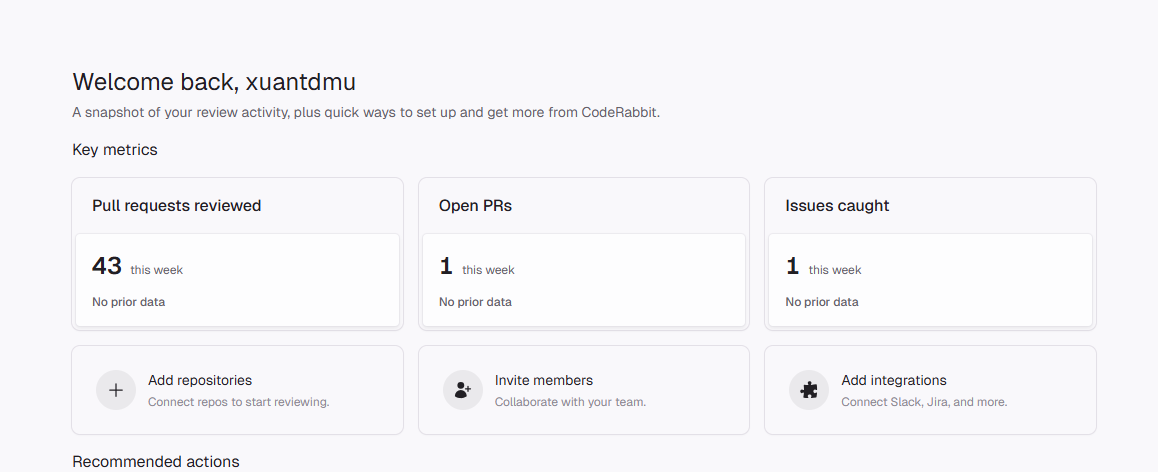
A typical PR summary CodeRabbit leaves on open
Limitations
Where it still can't replace a human
On architectural calls — say, whether to split a service out of the monolith — its feedback
stayed fairly generic, along the lines of "consider scalability" without engaging with the
specific context of the system. This is still a job for a senior engineer who actually
understands the product.
Also, in the first week the bot was a bit chatty — leaving comments on changes that didn't really
warrant them. After I pushed back a few times on unnecessary warnings, the noise dropped
noticeably, matching the "learning" behavior the team describes.
Worth noting
Fix suggestions still need a human sign-off — don't hit "commit fix" on reflex.
Curious what it catches in your own repo?
Connect a
repository
Scoring
Rated by category
Out of 10, based on personal experience in the test repo — not representative of every project type.
Bug-detection accuracy
Quality of PR summaries
Ease of fitting into an existing workflow
Architectural / system-level feedback
Value for money on a small team

An inline fix suggestion with a one-click commit
Summary
Pros and cons
Worth keeping
Solid PR summaries that save time reading diffs
Catches small bugs that human eyes tend to miss
Integrates smoothly with GitHub, no workflow overhaul
Gets quieter and more relevant the longer you use it
Worth weighing
Architectural feedback still feels generic
Noisy in the first week while it's "learning"
$24/dev/month is a real cost for a very small team
Auto-fixes still need human review before merging
Verdict
Is it worth using?
For teams where the volume of AI-generated code has outpaced how carefully a human can read it,
CodeRabbit is a reasonable filter — not perfect, but it catches exactly the kind of issues a rushed
review tends to miss. It won't replace a great reviewer, but it does guarantee every PR gets looked at
to some baseline standard, regardless of who's free that day.
If your bottleneck is "who's going to read all of this" rather than "who's going to write it" — worth
trying the free tier before paying for it.